 North Shore Plant Club
- Shop For Plants
- Search Plants
- Resources for Gardeners
- Color Wheel of Plants
- Interactive Landscapes
- Photos of Planters & Hanging Baskets
- October Photos from Our Community
- Botanic Gardens: Chicago & Beyond
- Local Nurseries
- Upcoming Plant Events
- Plant Club Articles & Answers
- Gardening in the News
- Chicagoland Garden Calendar
- Explaining Plant Container Sizes
- Thrillers, Fillers & Spillers
- Join Free!
- Mundelein
Jul 7, 2026
From Prairie Native to Garden Superstar: The History of the Coneflower
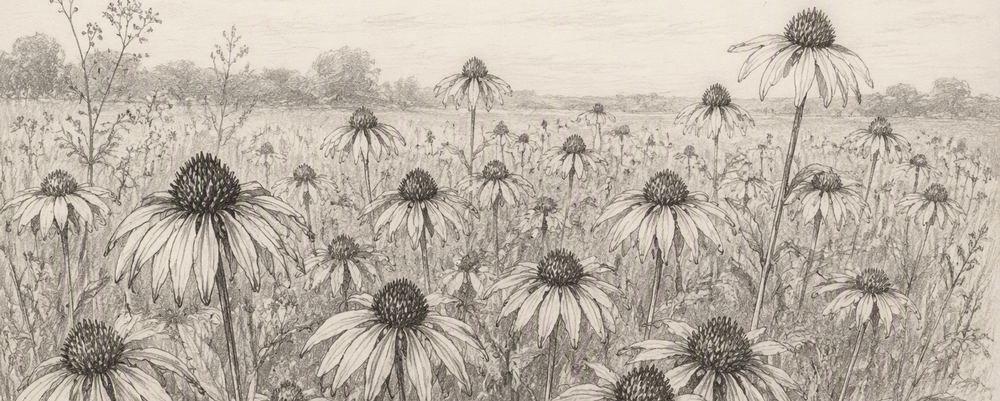
Few perennials have made a journey as remarkable as the coneflower (Echinacea). Once a wildflower of the American prairie, it has become one of the most recognizable and widely planted garden perennials in the world. Today’s gardeners can choose from coneflowers in shades of white, yellow, orange, scarlet, coral, green, and even near-black—yet all of these modern cultivars trace their ancestry back to a handful of native North American species.
For Midwestern gardeners, especially those of us in Illinois, the story of the coneflower is also a story of our native prairies and the growing appreciation of plants that are both beautiful and ecologically valuable.
A Prairie Original
The genus Echinacea is native exclusively to North America. Botanists generally recognize about ten species, all found in prairies, open woodlands, and grasslands stretching from the Great Plains eastward into the Midwest and Southeast. The name Echinacea comes from the Greek word echinos, meaning “hedgehog” or “sea urchin,” a reference to the spiny central cone that gives the flower its distinctive appearance — if you've ever touched the spiny center of the flower, you'll know why those names might have sprung to mind!
Several species are especially important to gardeners:
- Echinacea purpurea (Purple Coneflower)
- Echinacea pallida (Pale Purple Coneflower)
- Echinacea simulata (Wavyleaf Coneflower)
- Echinacea paradoxa (Yellow Coneflower)
- Echinacea angustifolia (Narrow-Leafed Coneflower)
The first three — purpurea, pallida, and simulata — are true Illinois natives, growing wild in the state's prairies and open woods. Echinacea paradoxa hails from the Ozark region of Missouri and Arkansas and Echinacea angustifolia from the drier Great Plains further west; both are garden-worthy relatives rather than Illinois natives which proved essential later on as breeding parents for new flower colors.
Long before European settlers arrived, indigenous peoples of the Great Plains and eastern woodlands valued coneflowers for their medicinal properties. Various tribes used roots, leaves, and flowers to treat wounds, burns, sore throats, toothaches, coughs, and snake bites. The roots produce a distinctive tingling sensation when chewed, a characteristic that helped make the plant one of North America’s most important traditional medicines.
From Native Medicine to Victorian Garden
European settlers quickly adopted coneflower as an herbal remedy. By the late 1800s, preparations containing Echinacea were widely sold in the United States. Interest spread to Europe, where the plant gained a reputation as both a medicinal herb and an attractive ornamental flower.
Yet for much of its early garden history, coneflower remained relatively simple. Gardeners typically grew straight species, especially Echinacea purpurea. These plants featured rosy-purple petals surrounding a coppery-orange cone and fit beautifully into naturalistic plantings. Their drought tolerance, long flowering season, and ability to attract butterflies made them increasingly popular during the late twentieth century.
As interest in prairie gardening grew during the 1970s and 1980s, coneflowers became staples of native plant gardens. Landscape designers such as Piet Oudolf and advocates of the New Perennial movement showcased the plant’s ability to provide structure, seasonal beauty, and winter interest long after flowering had finished. Seed heads left standing also supplied food for goldfinches and other birds.
The Cultivar Explosion
For decades, gardeners had only a few choices. Then breeders discovered something extraordinary: different species of Echinacea hybridized readily. Suddenly, an entirely new palette of flower colors and forms became possible.
Breeding efforts accelerated dramatically during the 1990s and early 2000s. One of the earliest widely admired cultivars was 'White Swan,' which offered elegant white petals while maintaining much of the vigor of the native species. This cultivar helped demonstrate that gardeners were eager for alternatives to the traditional purple flower. 'Magnus,' selected in the 1980s by Swedish plantsman Magnus Nilsson for its wide, flat, non-drooping petals, proved that the straight species could be improved through careful selection alone — it was named the Perennial Plant Association's Perennial Plant of the Year in 1998. Around the same time, designers like Piet Oudolf were putting coneflowers to spectacular use in naturalistic plantings, helping drive the New Perennial movement that made Echinacea a design staple far beyond its prairie origins.
The Chicago Botanic Garden's legendary breeder Dr. Jim Ault introduced the groundbreaking Meadowbrite series in the 2000s, including 'Art's Pride' (Orange Meadowbrite), the world's first orange coneflower, released in 2004, followed by one that's still popular, 'Pixie Meadowbrite.' Cultivars such as 'Magnus,' 'Ruby Star,' and 'White Swan' became garden favorites because of stronger stems, larger flowers, and improved performance.
Then came a wave of interspecific hybrids that transformed the market. Breeders crossed purple coneflower with species such as Echinacea paradoxa, the native yellow coneflower. For the first time, gardeners could grow flowers in shades of yellow, orange, coral, peach, red, and chartreuse.
Cultivars with evocative names like ‘Cheyenne Spirit’, ‘Hot Papaya’, ‘Tomato Soup’, ‘Marmalade’, and ‘Tiki Torch’ captured gardeners’ imaginations. Suddenly, coneflowers were no longer merely prairie wildflowers; they had become centerpiece plants for contemporary ornamental gardens.
Beauty versus Function
The breeding boom produced spectacular flowers, but it also raised an important question: do all coneflowers benefit pollinators equally?
Many newer cultivars feature double flowers, pompom centers, unusual petal arrangements, or heavily modified floral structures. While these forms may be visually striking, researchers and gardeners have observed that some produce less nectar and pollen than traditional single-flowered varieties. The pollen-rich central disk that attracts bees can be partially or completely transformed into decorative petals.
As a result, many ecologically minded gardeners now seek a balance between ornamental appeal and wildlife value. Single-flowered cultivars and straight species often provide the best resources for native bees, butterflies, and seed-eating birds. When shopping at the nursery, look at the center of the bloom. If you see a clear, exposed, spiny cone full of tiny yellow pollen florets, the bees and butterflies can use it. If the center looks like a fluffy pompom or a shredded mophead ('Hot Papaya', 'Pink Double Delight'), the reproductive parts have been bred into sterile petals—leave those for the cutting garden and stick to singles for the wildlife.
Coneflowers Today
Today’s gardener can choose from hundreds of cultivars, ranging from compact twelve-inch plants perfect for containers to towering prairie-style selections reaching four feet or more. The diversity is astonishing. A glance through a modern nursery catalog reveals names such as ‘White Showoff,’ ‘Fatal Attraction,’ ‘Sweet Chili,’ ‘Paradiso Super-Duper,’ ‘Mellow Yellows,’ and many others.
Yet despite all the breeding advances, the wild purple coneflower remains perhaps the most beloved of all. Its combination of rugged durability, drought tolerance, pollinator value, and natural beauty continues to win over gardeners year after year.
A Prairie Legacy
When you plant a coneflower in your garden, you are planting a living piece of North American history. Its ancestors once swayed across vast Midwestern prairies, nourished Indigenous communities, attracted generations of pollinators, and inspired breeders to create a dazzling array of modern cultivars. From humble native wildflower to international garden star, the coneflower’s journey reminds us that some of our finest garden plants were growing right outside our door all along.
For Illinois gardeners, that story feels especially meaningful: every purple coneflower blooming in a backyard border carries a little piece of the prairie with it. By planting them, we aren't just decorating our yards—we are acting as stewards of a magnificent, ancient landscape.
Browse the many coneflowers available from the North Shore Plant Club.