 North Shore Plant Club
- Shop For Plants
- Search Plants
- Resources for Gardeners
- Color Wheel of Plants
- Interactive Landscapes
- Photos of Planters & Hanging Baskets
- October Photos from Our Community
- Botanic Gardens: Chicago & Beyond
- Local Nurseries
- Upcoming Plant Events
- Plant Club Articles & Answers
- Gardening in the News
- Chicagoland Garden Calendar
- Explaining Plant Container Sizes
- Thrillers, Fillers & Spillers
- Join Free!
- Mundelein
Nov 12, 2025
The History of Boxwood: The Quiet Backbone of the Midwestern Garden
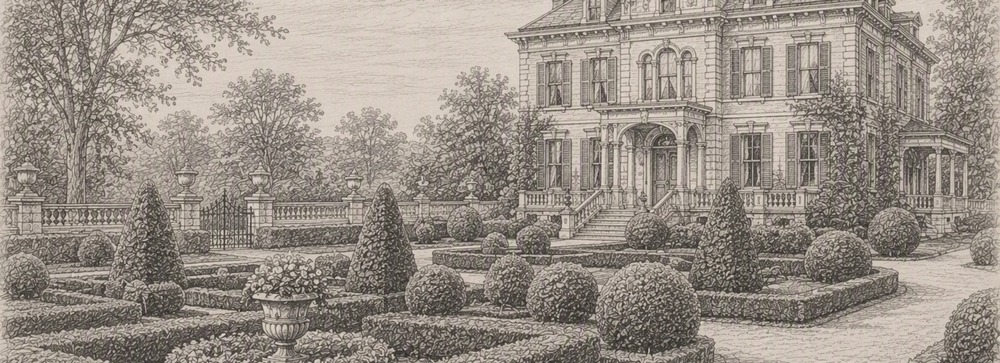
If hydrangeas are the stars of the summer garden and coneflowers are the pollinator magnets, then boxwood may be the unsung supporting actor that makes everything else look better. For centuries, gardeners have relied on boxwood to provide structure, year-round color, and a sense of permanence. In Chicagoland gardens, where perennial borders disappear beneath snow and shrubs can look ragged after a long winter, boxwood offers something precious: consistency.
Yet this familiar evergreen has a surprisingly rich history that stretches from ancient civilizations to modern suburban landscapes.
An Ancient Plant with Deep Roots
Boxwood belongs to the genus Buxus, a group of evergreen shrubs and small trees found across Europe, Asia, Africa, and the Americas. The species most familiar to gardeners, Buxus sempervirens (common boxwood), is native to parts of Europe, North Africa, and western Asia.
The plant has been valued for thousands of years. Ancient Egyptians, Greeks, and Romans used its remarkably dense wood to make combs, musical instruments, decorative carvings, and household objects. Because boxwood grows slowly, its wood develops an exceptionally fine grain that can be carved with great precision. Historical records suggest it was considered one of the finest woods available in the ancient world.
Long before it became a landscaping staple, boxwood was prized as much for its wood as for its foliage.
Rome's Influence on Garden Design
The Romans helped transform boxwood into a garden plant. Wealthy Roman estates commonly used clipped boxwood hedges to define walkways, frame courtyards, and create geometric designs. Roman gardeners discovered that boxwood tolerated repeated trimming and could maintain crisp shapes for years, making it ideal for formal gardens.
This tradition of shaping boxwood into hedges and topiary survived long after the fall of Rome. Medieval monasteries often planted boxwood in medicinal gardens and cloisters, where its evergreen leaves symbolized endurance and eternal life.
Boxwood and the Great European Gardens
During the Renaissance and Baroque periods, boxwood became one of the defining plants of European garden design. French, Italian, and English estates used low boxwood hedges to create elaborate knot gardens, parterres, and formal geometric layouts. The clipped green lines provided year-round architecture, even when flowers were absent.
Many of the famous gardens of Europe—from French châteaux to English manor houses—still feature boxwood designs established centuries ago. Gardeners appreciated that boxwood could be shaped into nearly any form while remaining dense and elegant.
Its popularity was not universal, however. Some historical writers complained about the shrub's distinctive scent on warm days. Queen Anne of England famously hated the smell of boxwood so much that she had miles of boxwood hedges ripped out of the royal gardens at Hampton Court in the early 1700s. Fortunately, many modern cultivars have been bred not just for cold hardiness but also to lack the pungent scent of their ancestors.
The Journey to North America
Boxwood crossed the Atlantic surprisingly early. Historical records indicate one of the first documented plantings in North America occurred around 1653 at Sylvester Manor on Shelter Island, New York, using plants brought from Amsterdam.
Colonial gardeners quickly embraced the shrub. Its orderly appearance matched European gardening traditions, and its evergreen nature was especially valuable in winter landscapes.
By the nineteenth century, boxwood had become one of America's most popular ornamental shrubs. It became particularly associated with Colonial Revival gardens and grand Southern estates, where clipped hedges framed homes, pathways, and flower beds. Many of these historic plantings survive today.
Finding a Home in the Midwest
Although boxwood is often associated with the Mid-Atlantic and South, it gradually earned a place in Midwestern landscapes as breeders introduced more cold-hardy selections. Chicago-area gardeners learned that certain varieties could withstand harsh winters better than others.
In the late 19th and early 20th centuries, Chicago went through the "City Beautiful" movement, heavily influenced by the 1893 World's Columbian Exposition. This era sparked a massive trend toward formal European-style landscapes, parterres, and clipped hedges in wealthy Chicago neighborhoods (like the Gold Coast and Prairie Avenue) and early suburbs (like Lake Forest) as boxwood was used to emulate European refinement.
Both the Chicago Botanic Garden and Morton Arboretum have spent decades running plant evaluation trials to improve boxwood cultivars for northern winters. One standout result is 'Chicagoland Green®' (Buxus 'Glencoe'), a joint Chicagoland Grows® introduction from the Chicago Botanic Garden and Morton Arboretum, selected for its uniform habit and reliable winter color even after brutal cold snaps. Northern gardeners have also come to rely on 'Green Mountain,' bred by Sheridan Nurseries in Ontario, Canada, in the mid-1960s — not a Chicago-area introduction, but a cultivar whose cold hardiness has made it a standout performer in local trials and gardens alike.
Today, boxwood is one of the most commonly used foundation shrubs in Chicagoland gardens. It anchors mixed borders, defines entrances, lines pathways, and serves as a reliable evergreen companion to hydrangeas, hostas, roses, and countless perennials.
Part of the appeal is that boxwood provides structure during all four seasons. In July it frames colorful borders. In October it complements fall foliage. In January it stands above the snow, still offering form and color.
The Rise of New Cultivars
For generations, gardeners often referred simply to "American" or "English" boxwood. However, modern horticulture has dramatically expanded the choices available.
Today there are dozens of commercially available species and cultivars, including compact forms, upright forms, globe-shaped varieties, and selections bred for improved winter hardiness. Asian species and hybrids have contributed valuable traits such as disease resistance and cold tolerance.
Popular varieties found in northern gardens include 'Green Mountain,' 'Winter Gem,' 'Wintergreen,' and 'North Star,' among others. These selections have helped make boxwood more dependable across the upper Midwest.
A New Threat: Boxwood Blight
No history of boxwood would be complete without discussing one of the biggest challenges facing the plant today.
Boxwood blight, a fungal disease first identified in 1994 at a single nursery in southern England, spread through the UK and continental Europe over the following decade. It crossed the Atlantic in October and November of 2011, when it was first detected in the U.S. on boxwood samples from North Carolina and Connecticut — turning what had been a European problem into a domestic one almost overnight. The disease can cause rapid leaf drop, stem lesions, and overall decline, and because its spores can survive for years and spread easily on tools, clothing, and even holiday greenery, it has become a significant concern for homeowners, nurseries, and public gardens alike.
Researchers and breeders have responded by evaluating hundreds of cultivars and identifying selections with better resistance. Local landscapers now emphasize proper spacing for air circulation, or that gardeners are clean-pruning rather than shearing to prevent the dense, moisture-trapping canopies where the fungus thrives.
Why We Still Love Boxwood
In an era when gardeners are constantly seeking the newest perennial or most colorful shrub, boxwood remains remarkably relevant.
It serves as a frame for seasonal flowers. It creates order when gardens become exuberant. It provides winter interest when nearly everything else has faded. And it links today's landscapes to centuries of gardening tradition.
For Chicagoland gardeners, that durability may be its greatest strength. Our gardens face cold winters, hot summers, heavy clay soils, and increasingly unpredictable weather. Through it all, a well-placed boxwood continues doing what it has done since Roman times—quietly holding the garden together.
That may not be flashy, but after nearly two thousand years of garden history, it is hard to argue with success.