 North Shore Plant Club
- Shop For Plants
- Search Plants
- Resources for Gardeners
- Color Wheel of Plants
- Interactive Landscapes
- Photos of Planters & Hanging Baskets
- September Photos from Our Community
- Botanic Gardens: Chicago & Beyond
- Local Nurseries
- Upcoming Plant Events
- Plant Club Articles & Answers
- Gardening in the News
- Chicagoland Garden Calendar
- Explaining Plant Container Sizes
- Thrillers, Fillers & Spillers
- Join Free!
- Mundelein
Mar 11, 2026
History of Hellebores: From Ancient Medicine to Winter Garden Star
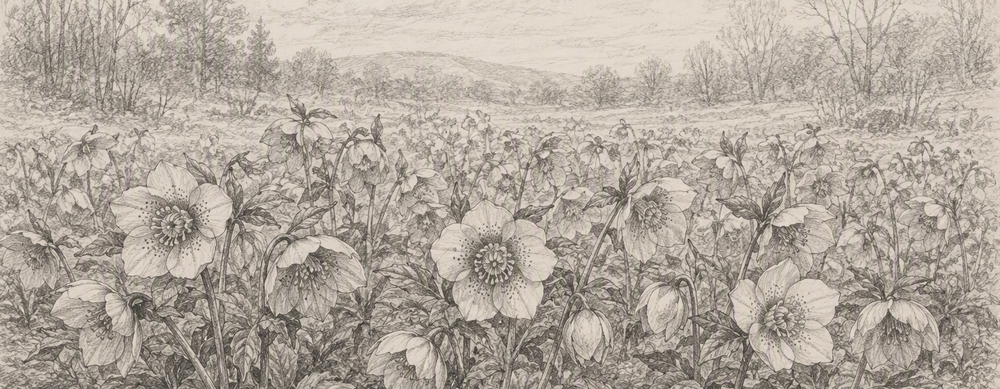
Often called Lenten rose or Christmas rose, hellebores belong to the genus Helleborus, part of the buttercup family (Ranunculaceae). These plants, whose blooms break through the snow in March, were already in human gardens thousands of years ago.
Their story begins in the rocky hills and woodlands of Europe and western Asia.
The earliest hellebores evolved in regions stretching from the Mediterranean Basin through the Balkans and the Caucasus Mountains. These plants adapted to harsh conditions—thin soils, cold winters, and dry summers—developing tough, leathery leaves and an unusual flowering habit. Unlike most plants, hellebores bloom in late winter or early spring, sometimes pushing flowers through snow. This ability made them stand out long before gardens as we know them existed.
In ancient Greece, hellebores were known primarily for their medicinal—and sometimes dangerous—properties. Greek physicians used extracts of Helleborus orientalis and Helleborus niger as purgatives, believing the plant could cure madness, melancholy, and epilepsy. One famous legend claims hellebore was used to restore the sanity of the daughters of King Proetus, giving rise to its reputation as a powerful, if risky, remedy. Because the plant is toxic, its use required great caution, and hellebores earned an aura of mystery and respect.
The Romans continued to use hellebores medicinally, but also began to appreciate their ornamental qualities. Helleborus niger, native to alpine regions, became associated with winter festivals and was reportedly cultivated near Roman villas. As Christianity spread through Europe, hellebores took on new symbolic meanings. The Christmas rose, flowering near midwinter, became linked to purity and humility in Christian legend, further cementing its place in monastery gardens.
Throughout the Middle Ages, hellebores remained plants of both superstition and utility. They were believed to ward off evil spirits and were sometimes planted near doorways for protection. Monastic gardeners preserved and propagated hellebores, ensuring their survival through centuries when ornamental gardening was limited.
It was not until the 18th and 19th centuries that hellebores began their transformation into true garden plants. European plant explorers and botanists collected new species from the Balkans and Asia Minor, introducing greater diversity in flower color, leaf shape, and plant size. Gardeners began selecting plants for beauty rather than medicinal value, favoring longer-lasting blooms and improved vigor.
The greatest change came in the 20th century with deliberate hybridization. Early modern breeders began crossing Helleborus orientalis with related species to expand flower color, form, and garden performance, producing what we now call Helleborus × hybridus, or hybrid hellebores. Instead of the simple white or green flowers common in older plants, these hybrids revealed new shades of rose, plum, slate, and near black, often decorated with spots, picotee edges, or veining. This group of plants became known collectively as Helleborus × hybridus.
Equally important were improvements to plant habit. Breeders selected for stronger stems, outward facing flowers, and improved vigor, making hellebores more visible and reliable in garden settings. In the late 20th century, attention also turned to double flowers, anemone centered forms, and improved evergreen foliage, elevating hellebores from woodland curiosities to centerpiece perennials.
Improvements in controlled breeding have brought us a much wider range of hellebores with longer bloom times, upright flowers that resist weather damage, and colors once thought impossible. Seed strains and named cultivars now offer remarkable diversity, while still retaining the toughness and longevity hellebores are known for.
Today, hellebores are prized garden perennials, especially valued for their ability to bloom when little else does. They thrive in woodland settings, beneath deciduous trees, and in shade gardens where winter interest is often scarce. Modern gardeners appreciate hellebores not only for their beauty, but for their toughness, longevity, and resistance to deer and rabbits.
From ancient medicine and folklore to modern shade gardens, hellebores have traveled a remarkable path. Their quiet winter blooms remind us that beauty can emerge even in the coldest, darkest seasons—a lesson gardeners have embraced for centuries.