 North Shore Plant Club
- Shop For Plants
- Search Plants
- Resources for Gardeners
- Color Wheel of Plants
- Interactive Landscapes
- Photos of Planters & Hanging Baskets
- October Photos from Our Community
- Botanic Gardens: Chicago & Beyond
- Local Nurseries
- Upcoming Plant Events
- Plant Club Articles & Answers
- Gardening in the News
- Chicagoland Garden Calendar
- Explaining Plant Container Sizes
- Thrillers, Fillers & Spillers
- Join Free!
- Mundelein
Oct 15, 2025
Living Fossils in the Garden: Ancient Plants You Can Grow in Chicago
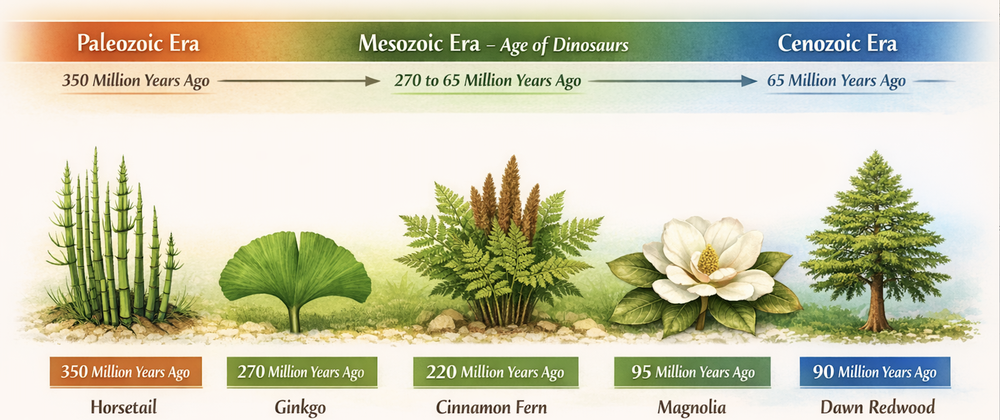
National Fossil Day is a perfect moment to look beyond bones and stones and celebrate something remarkable growing quietly around us: living fossils. These are plants whose modern forms closely resemble their ancient ancestors, sometimes stretching back hundreds of millions of years. While dinosaurs are long gone, many of the plants they knew are still thriving—and several can be found right here in Chicago area gardens.
These plants are not “unchanged relics,” but rather survivors—species that evolved early, adapted well, and found no reason to reinvent themselves. Planting them is like creating a living museum, one that connects our gardens to deep time.
Horsetail (Equisetum)
Horsetails are among the oldest vascular plants on Earth, with ancestors dating back more than 350 million years. Long before flowering plants evolved, vast forests of horsetail relatives towered over swampy landscapes.
Modern horsetail looks almost prehistoric: jointed, hollow stems with a rigid, bamboo like appearance. It has no flowers or seeds, reproducing instead by spores. In Chicagoland, horsetail thrives in moist soils and is often found along ditches, ponds, and rain gardens. Gardeners should be cautious—horsetail can spread aggressively—but grown in containers or controlled areas, it’s a fascinating conversation piece.
Ferns
Ferns as a group predate flowering plants and dinosaurs by many millions of years, appearing between 360-390 million years ago during the Devonian period. Cinnamon ferns are a standout example... Fossils nearly identical to today’s cinnamon fern appear in rocks over 180 million years old.
This native fern is well suited to Chicago’s climate, especially in shady, moist sites. In spring, it unfurls classic fiddleheads, while its upright, cinnamon colored fertile fronds give the plant its common name. Cinnamon fern brings both ancient lineage and graceful texture to woodland gardens, reminding us that shade gardening has deep evolutionary roots.
The genus Adiantum containing Maidenhair ferns dates back to at least the Late Jurassic, with fossil evidence over 150 million years old. While individual species evolved later, the overall form is ancient and recognizable. Northern maidenhair fern (Adiantum pedatum) is native to Illinois and a classic shade garden favorite, especially in rich, moist woodland soils. It’s an elegant counterpoint to the bolder cinnamon fern—and a great example of ancient plants that feel surprisingly refined.
Ginkgo (Ginkgo biloba)
Perhaps the most famous living fossil, the ginkgo is the sole surviving member of an entire plant division. Ginkgo-like trees once grew across much of the globe, and fossils dating back over 200 million years show leaves almost indistinguishable from those falling on Chicago sidewalks today.
Exceptionally tolerant of pollution, road salt, and compacted soils, ginkgo has become a beloved urban tree. Its fan shaped leaves turn a luminous yellow in fall, making it a standout in city landscapes. Planting a ginkgo is like planting a tree that dinosaurs once walked beneath—and one that will likely outlive us all.
Magnolia
Magnolias evolved before bees, which explains their large, sturdy flowers designed for beetle pollination. Fossil magnolias date back more than 100 million years, making them some of the earliest flowering plants.
Several magnolia species and hybrids grow well in the Chicago area, including star magnolia and saucer magnolia. Their early spring blooms feel almost primeval—big, bold, and unapologetically showy—offering a glimpse of what early flowering plants may have looked like when the world was young.
Bald Cypress (Taxodium distichum)
Bald cypress has a fossil record extending back to the Cretaceous Period, and modern trees are nearly identical to fossil specimens. It’s closely related to dawn redwood and shares the rare trait of being a deciduous conifer. Hardy in northern Illinois, bald cypress is uniquely tolerant of wet soils but adapts surprisingly well to average garden conditions. It’s already planted in parks and arboretums across the region. Those iconic “knees” and copper fall color make it visually distinctive.
Dawn Redwood (Metasequoia glyptostroboides)
The dawn redwood is a botanical miracle story. Known only from fossils until the 1940s, it was rediscovered alive in China—an actual “extinct” tree brought back into the living world. Fossils show that dawn redwoods once grew widely across the Northern Hemisphere.
This fast growing, deciduous conifer is hardy in Chicagoland and increasingly planted in parks and large landscapes. Its soft, feathery needles turn a warm copper color in fall before dropping, combining ancient lineage with modern ornamental appeal.
Gardening Through Deep Time
Growing living fossils invites us to slow down and think bigger. These plants survived mass extinctions, shifting continents, and ice ages—and now they share space with raised beds, patios, and parkways. On National Fossil Day, they remind us that gardens are not just seasonal displays, but chapters in a story hundreds of millions of years long.
When you plant a living fossil, you’re not just gardening—you’re curating time itself.