 North Shore Plant Club
- Shop For Plants
- Search Plants
- Resources for Gardeners
- Color Wheel of Plants
- Interactive Landscapes
- Photos of Planters & Hanging Baskets
- September Photos from Our Community
- Botanic Gardens: Chicago & Beyond
- Local Nurseries
- Upcoming Plant Events
- Plant Club Articles & Answers
- Gardening in the News
- Chicagoland Garden Calendar
- Explaining Plant Container Sizes
- Thrillers, Fillers & Spillers
- Join Free!
- Mundelein
Feb 14, 2026
Smart Plant Buying for Successful Patio Pots
One of the most common questions club members ask us each spring is: “How many plants should I buy for my pots?” Closely followed by: “What size plants are best?” and “How much variety is too much?” The answers matter—not just for beauty, but for plant health, ease of care, and budget. Patio containers are small ecosystems, and thoughtful plant selection at the garden center sets the stage for success all season long.
This guidance will help club members shop with confidence and plant patio pots that look good in May and still thrive in August.
Start With the Container, Not the Plants
Before buying a single plant, gardeners should decide what size pot they are planting. Container diameter—not height—is the most important measurement because it determines how much root space is available.
A helpful rule of thumb is this: The larger the pot, the fewer plants per square inch you actually need. Bigger containers allow plants to grow to their natural size and fill in over time.
Typical guidelines:
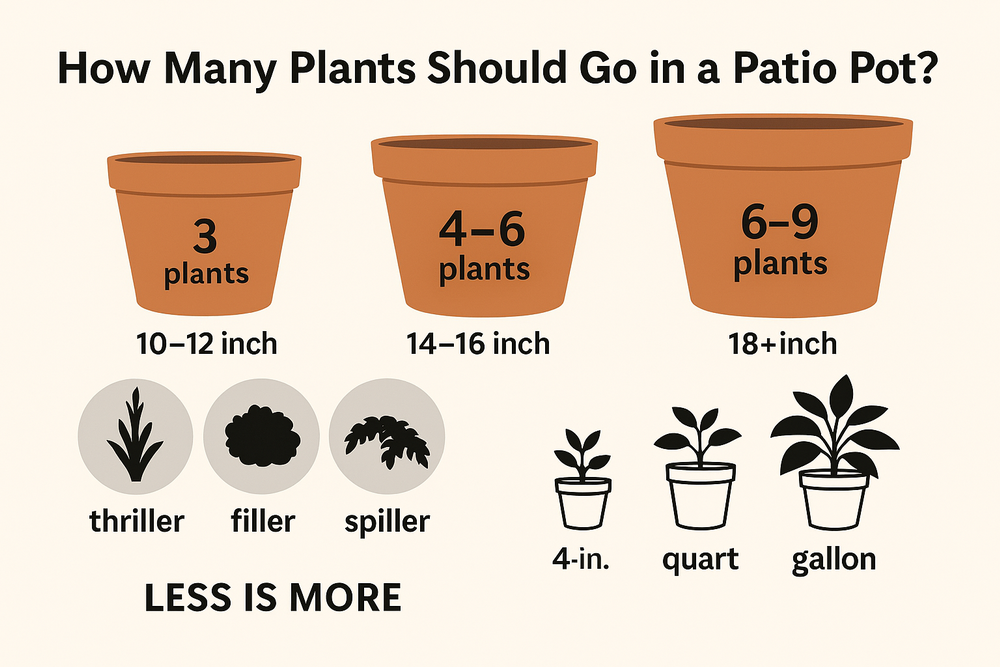
- 10–12 inch pots (small patio pots, window boxes) → 3 plants total
- 14–16 inch pots (most standard patio containers) → 4–6 plants total
- 18–20 inch pots (large statement containers) → 6–9 plants total
- 24 inch or larger tubs and urns → 9–13 plants total, often fewer if plants are large or vigorous
Gardeners often overbuy because containers look “empty” on planting day. Remember that plants grow quickly in warm weather, and slightly underfilled pots almost always outperform crowded ones.
Think in Roles: Structure Matters More Than Quantity
Rather than counting plants randomly, encourage gardeners to think in roles. Most successful patio pots rely on three basic plant types:
- Structural plants (sometimes called "Thrillers") provide height or strong form...
- Mounding plants ("Fillers") fill the middle and add mass...
- Trailing plants ("Spillers") soften edges and spill over rims.
For most containers, the "Thriller Filler Spiller" scheme translates into 1 structural plant, 2-4 mounding plants, and 1-3 trailing plants. This structure keeps pots visually balanced and prevents the “plant soup” effect that happens when too many similar plants are packed together.
Plant Size: Bigger Isn’t Always Better
Gardeners often assume larger nursery pots mean better results. In containers, that’s only sometimes true.
Small plants (4-inch pots)
- Less expensive
- Establish quickly
- Best for fillers and spillers
- Ideal when planting many containers
Medium plants (quart or 1‑liter pots)
- The best all‑around choice for patio pots
- Fill space well without overcrowding
- Strong root systems without being rootbound
Large plants (1‑gallon or larger)
- Excellent as focal or structural plants
- Use sparingly—usually one per container
- Can dominate small pots and crowd others
A good guideline for club members: Match plant size to its role. Buy one larger plant for structure, then fill in with medium or small plants around it.
Variety: Aim for Harmony, Not a Plant Collection
Another common mistake is buying too many different plants for a single pot. Variety is appealing at the garden center, but containers need restraint.
For most patio pots:
- 3–5 different plant varieties is ideal
- More than 6 varieties often looks busy and chaotic
- Repeating the same plant twice improves cohesion
Encourage members to repeat plants within a pot or across multiple pots on a patio. Repetition creates calm and makes displays look intentional rather than accidental.
Growth Habit Matters More Than Label Height
Plant tags list mature height, but growth habit is even more important. Some plants grow straight up, others mound wide, and some race outward aggressively.
When buying plants, gardeners should ask:
- Will this plant grow wider than it is tall?
- Does it trail gently or run aggressively?
- Does it bulk up early or late in the season?
Aggressive growers (such as certain trailing vines or fast-spreading annuals) should be used sparingly—often one per pot is enough. Slower growers can be planted closer together.
Speaking of aggressiveness, if some plants in your container grow much more quickly than others, those will tend to take over at the expense of the other plants and the artistic balance of your container. When you're hoping to get a whole season's enjoyment, you'll typically want to work with plants of similar "vigor."
Spacing: Give Roots Room to Work
Overcrowding is the fastest way to a disappointing container by midsummer. Roots compete for water and nutrients long before foliage looks crowded.
A helpful visual rule:
- Plants should just touch leaves after planting, not overlap heavily.
- Soil should still be visible between plants on day one.
If a pot looks slightly sparse at planting time, that’s usually perfect.
Budgeting: Buy Fewer Plants, Better Plants
For garden club members planting multiple containers, costs add up quickly. The best advice is simple:
Spend money on pot size and soil first, plants second.
A large container with fewer plants almost always outperforms a small pot packed with many plants. Encourage members to:
- Buy fewer plants per pot
- Invest in healthy, well-grown specimens
- Avoid impulse additions that don’t fit the plan
Special Situations to Think About
- Shady patios: Plants grow more slowly. Use fewer plants and avoid aggressive growers.
- Hot, sunny patios: Plants grow faster and drink more. Allow extra space and avoid crowding.
- Older club members: Heavier pots with fewer plants are often easier to maintain than overstuffed containers that require constant watering.
A Simple Shopping Checklist
Before heading to the nursery, gardeners should think about:
- Pot size (diameter)
- Sun exposure
- How many plants you need—maximum
- One structural plant you love
- Two or three plants to repeat
If you can answer those five things, you will almost always come home with the right amount of plant material.
Less Is Almost Always More
The most successful patio pots are not the ones with the most plants—they are the ones where each plant has room to shine. Teaching garden club members to buy fewer plants, in appropriate sizes, with thoughtful variety will lead to healthier containers, less maintenance, and more satisfaction all season long.