North Shore Plant Club
- Shop For Plants
- Search Plants
- Resources for Gardeners
- Color Wheel of Plants
- Interactive Landscapes
- Photos of Planters & Hanging Baskets
- November Photos from Our Community
- Botanic Gardens: Chicago & Beyond
- Local Nurseries
- Upcoming Plant Events
- Plant Club Articles & Answers
- Gardening in the News
- Chicagoland Garden Calendar
- Explaining Plant Container Sizes
- Thrillers, Fillers & Spillers
- Join Free!
- Mundelein
Oct 30, 2026
To Rake or Not to Rake? Smarter Fall Cleanup for North Shore Gardens!
For most North Shore gardens, the best fall cleanup is neither a full strip-down nor a hands-off "leave everything" approach. It is selective: clear what causes problems, keep what does good, and treat different parts of the yard differently.
For generations, the autumn ritual has been the same. Rake the lawn, blow the leaves out of the beds, cut everything to the ground, bag it up, and leave the garden looking neat before winter. There is real satisfaction in that. After months of growth, everything looks orderly again.
Lately the advice has flipped. "Leave the leaves." Don't cut the perennials. Don't touch anything until spring. Let the insects overwinter and let nature take its course.
Both camps are partly right, and both cause trouble when taken to extremes. This article explains why we started cleaning so thoroughly, why the newer thinking has merit, which approach actually wins, and a step-by-step way to do it in a Chicago-area garden.
Why we started cleaning beds so thoroughly
Traditional cleanup was never only about looks. Gardeners removed leaves and dead growth for three practical reasons, and each still holds in the right situation.
1. A thick, wet mat of leaves can smother plants. A few leaves scattered among perennials are harmless. A dense blanket of big leaves is not. Norway maple, sugar maple, sycamore, and catalpa leaves settle into beds, soak up fall rain and snow, and press into a heavy, airless layer. Low evergreens, groundcovers, rock-garden plants, and small perennial crowns can rot or suffocate underneath, and early risers like hellebores, snowdrops, and crocus struggle to push through in March. The question is never "are leaves good or bad?" It is "how many, what kind, and what are they sitting on?"
2. Sanitation reduces some diseases. If a plant had a serious foliar disease this year, its fallen leaves and stems hold the spores that restart the problem next year. Peonies with botrytis, roses with black spot, bee balm or phlox with heavy powdery mildew, and tomatoes with early blight all deserve a thorough cleanup. Healthy ornamental grasses and native perennials do not. The distinction that matters is healthy organic matter versus diseased debris; they are not the same thing.
3. It lightens the spring workload. In northern Illinois, spring arrives fast. One week the ground is frozen; a couple of weeks later bulbs are up, perennials are breaking dormancy, and there is suddenly far too much to do. Removing the worst of the debris in fall means less waiting for you in April. But that does not require scraping every bed down to bare mulch.
Why gardeners are leaving more behind
The newer thinking rests on one observation: the garden does not stop being habitat when the flowers stop blooming. Leaves, stems, and seed heads keep working through fall and winter.
Fallen leaves are free soil improvement. Nobody rakes a forest. Leaves fall, break down, and return organic matter and nutrients to the soil. The same thing happens in an ornamental bed. A loose layer of leaves protects soil from erosion, buffers freeze-thaw swings that heave shallow-rooted perennials, holds moisture, feeds earthworms and soil fungi, and shades out some winter annual weeds like chickweed and henbit. This does not mean letting three feet of leaves pile against the house. It means a few inches of leaves in a bed are useful, not untidy.
Insects really do overwinter in garden debris. This is the strongest argument against aggressive cleanup. Many beneficial insects spend winter in leaf litter, hollow stems, or the top inch of soil: fireflies, lady beetles, lacewings, native bees, and the chrysalises and eggs of swallowtails, mourning cloaks, and other butterflies and moths. When every scrap is shredded, blown, and bagged in October, the habitat goes with it. Standing perennial stems matter too. Hollow or pithy stems of bee balm, Joe Pye weed, coneflower, and ironweed become nest sites for small native bees the following summer.
Winter structure and food. Seed heads of coneflower, black-eyed Susan, and native grasses feed goldfinches, juncos, and chickadees through the cold months, and they look good doing it. Ornamental grasses rimed with frost or coneflower heads standing above fresh snow are not a failure of tidiness. They are the winter garden.
The old goal was a clean garden. A better goal is a healthy garden that still looks intentional.
So which is better?
Selective cleanup wins, and it is not close. A full strip-down costs you free mulch, soil life, pollinator habitat, and winter interest, and it fights a losing battle against next week's wind. A hands-off approach lets wet maple mats kill groundcovers, lets diseases carry over, and buries early bulbs. The selective approach keeps the benefits of both and the drawbacks of neither.
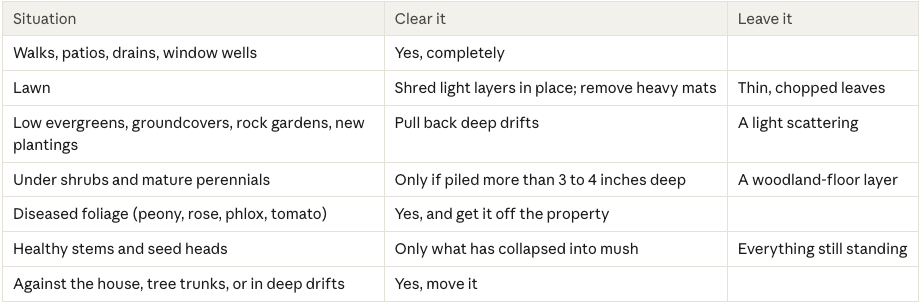
You'll find the same decision in one quick-reference table at the end of this article.
A word about leaf blowers
Use the blower as a mover, not a vacuum. It is the right tool for walks, driveways, and big lawns under mature oaks and maples. In a planting bed it needs a lighter touch.
A full-throttle blast aimed into the base of perennials strips far more than leaves. It scatters mulch, exposes soil and shallow roots, snaps stems, and blows away exactly the organic matter and overwintering insects you may want to keep. And anyone who has cleaned a mature garden knows the sequel: you blow the bed spotless Saturday, the wind shifts Sunday, and by Monday the leaves are back.
A better approach:
- Run it at low speed in beds, and aim across the surface rather than down into crowns.
- Use it to redistribute: push excess off vulnerable plants and toward shrub borders, the compost area, or a leaf-mold pile where it does some good.
- Finish detail work around delicate plants with a spring rake or your hands.
- Rake leaves off the lawn onto a tarp and drag them to where they are needed, rather than chasing every leaf with the blower.
That turns the blower from a cleaning tool into a garden-management tool.
Fall cleanup, step by step
Instead of asking "should I clean up?", walk the garden and make a different decision for each area. Work in this order, and spread it over several weekends; it does not need to be done in a day.
When to start. Wait for the bulk of the leaves to come down and for a hard freeze (28°F or lower) to end the season, usually mid to late November along the North Shore. Cleaning up in mid-October just means doing it twice.
- Clear the hard surfaces and drainage first. Walks, steps, patios, driveways, storm drains, gutters, window wells, and exterior stairwells should be fully clean. Wet leaves are a slipping hazard and a clogged drain is a basement problem. Keep piles away from siding and foundations. Here, neat and safe are the same thing.
- Keep heavy leaves from matting on the lawn. A light layer can simply be mowed in; a mulching mower chops leaves fine enough that they vanish into the turf and feed it. Mow when the leaves are dry, and if you still see more leaf than grass after a pass, the layer is too thick. Rake or bag the excess, but "collect" does not mean "throw away." See "Put those leaves to work" below.
- Pull leaves back from vulnerable plants. Walk the beds rather than blowing everything bare. Give special attention to low ornamental evergreens, groundcovers like pachysandra and sedum, newly planted perennials, rock-garden plants, hellebores and early bulbs, and anything with a crown that rots in winter wet (lavender, coral bells, dianthus). Gently rake or blow off deep drifts. You do not need to see bare soil afterward. That is the key difference.
- Leave a modest layer where it does no harm. Under shrubs, trees, and mature perennials, a 2 to 4 inch layer can stay all winter. If the leaves are large or mat easily (maple, sycamore), chop them first with the mower; shredded leaves settle, look deliberate, and break down by summer. Oak leaves are leathery and slow to decompose, which makes them excellent mulch but also worth shredding. Aim for a woodland floor, not a municipal leaf pile. You should still be able to tell there is a bed underneath.
- Be ruthless with diseased material. Remove foliage and stems from plants that had serious disease, along with rotting fruit and collapsed vegetable plants. Bag it or put it in yard waste; do not compost it unless your pile runs reliably hot. This is sanitation, not housekeeping. Healthy oak leaves under a viburnum and black-spotted leaves under a rose should not get the same treatment.
- Cut back selectively. Details in the next section.
- Mulch and water in. Once beds are sorted, top up mulch where it has thinned and give evergreens and fall plantings a deep watering before the ground freezes. Dry winter soil, not cold, is what kills most new boxwoods and arborvitae.
What to cut down and what to leave standing
The same selective rule applies to perennials. There is no reason to cut everything to the ground just because it is November.
A useful test: if it is still upright, healthy, and structurally interesting, leave it. If it has collapsed into soggy or diseased debris, remove it. That will not cover every plant, but it is a far better starting point than "cut it all down."
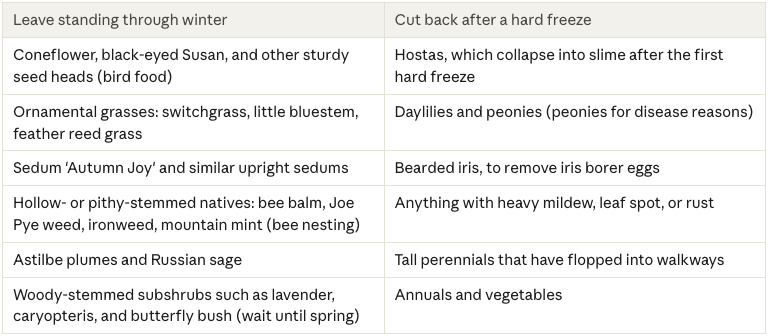
When you do cut back stems you want to keep for bees, leave 12 to 18 inches standing rather than cutting flush. The stubs are nearly invisible once spring growth comes up and they provide the nest sites.
Hydrangeas: put the pruners down. This is where enthusiastic fall cleanup causes real disappointment the following July. Hydrangeas bloom in two different ways, and cutting the wrong kind in fall removes next year's flowers.
- Panicle ('Limelight', 'Quick Fire', 'Bobo') and smooth ('Annabelle', 'Incrediball') hydrangeas bloom on new wood. They tolerate fall pruning, but late winter is still the better time, and the dried heads are handsome in snow.
- Bigleaf ('Endless Summer', 'Nikko Blue'), oakleaf, and climbing hydrangeas bloom mostly on old wood. Those stems already carry next summer's buds. Do not cut them in fall; only remove clearly dead wood in spring once you can see what is leafing out.
If you are not sure which hydrangea you have, do nothing this fall. Restraint costs you nothing.
Put those leaves to work
If your property makes more leaves than the beds can hold, you still have better options than the curb.
Make leaf mold. One of the best soil amendments you can get is also the easiest to make. Pile leaves in an out-of-the-way corner, corral them in a ring of wire fencing if you like, keep the pile damp, and let fungi do the work. In 12 to 24 months (half that if shredded) you get dark, crumbly leaf mold that holds water like a sponge. Use it as mulch, dig it into new beds, or mix it into containers. It is slow precisely because it is effortless.
Add leaves to compost. Leaves are the carbon-rich "brown" every compost pile needs. Layer them with nitrogen-rich "greens" such as grass clippings, spent annuals, and kitchen scraps, roughly two to three parts leaves to one part greens, rather than building one dense block of leaves. Shredded leaves break down several times faster than whole ones. Bag a few extra to balance the grass clippings next summer.
Use shredded leaves as mulch. Run leaves over with the mower, then spread 2 to 3 inches around shrubs and perennials. Chopping stops matting, makes the bed look intentional, and the price per bag is hard to beat.
Keep leaves and mulch off tree trunks. Organic material is good over the root zone and bad against bark. Wet leaves or mulch piled against a trunk hold moisture against it, invite rot and rodents, and encourage girdling roots. Pull everything back 3 to 6 inches from the trunk and spread it outward instead. The "mulch volcano" is bad practice whether it is made of wood chips or autumn leaves. Think doughnut, not volcano.
How clean should the garden look going into winter?
Not immaculate. Not abandoned. Managed.
A well-prepared North Shore garden in December has clear walks, patios, and drains; a lawn with no visible leaf layer; a few inches of leaves under the shrubs and shredded leaves among the perennials; grasses and seed heads standing; healthy stems left for structure and habitat; diseased material gone; low evergreens and early bulbs free of heavy mats; and the surplus leaves composting quietly in a corner.
To anyone used to bare mulch by Thanksgiving, that can look slightly untidy at first. Look again. There is a difference between disorder and dormancy.
Don't rush the spring cleanup either
"Leave the leaves until spring" is good advice, but it needs judgment at the other end too. Spring cleanup should not begin on the first 60-degree afternoon in March. Along the lake, early warm spells are notoriously deceptive, and the insects sheltering in that debris do not emerge the day you feel like gardening.
There is no single safe date. A practical rule is to wait until daytime temperatures hold consistently in the 50s for a week or so, typically mid to late April here, then remove material in stages as plants begin to grow, rather than one big early purge. Cut standing stems before new growth tangles with them, and leave the cut pieces in a loose pile at the edge of the yard for a few weeks so anything still inside can finish emerging. Some leaves can stay indefinitely and simply disappear into the soil.
The rule that covers almost everything
Our picture of a well-kept fall landscape has been shaped by neatness. Bare mulch looks cared for; a perfectly edged bed looks finished. But plants do not experience winter according to our definition of tidy. A little decay is how a garden recycles itself. Standing stems are architecture, seed heads are food, and leaves are insulation and, eventually, soil.
None of that means giving up fall cleanup. It means being precise about why you are cleaning. Remove something because it is diseased. Move leaves because they are smothering a plant. Clear the walk because wet leaves are slippery. Cut a perennial because it has collapsed into a mess. But do not strip healthy leaves, stems, and seed heads just because tradition says the beds should be bare by Thanksgiving.
Clear what needs clearing. Remove what can cause problems. Leave what can do some good.
Done that way, fall cleanup stops being a battle against nature and becomes a way of preparing the garden for winter while leaving enough behind for everything else that lives there. And you will spend a lot less time chasing that last stubborn leaf across the flower bed.
Quick reference: clear it or leave it?