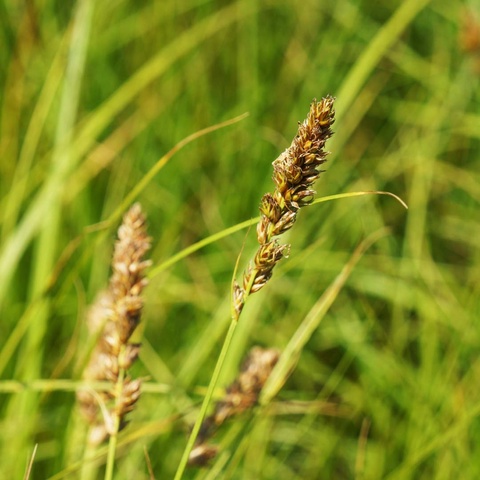
Deciduous Perennial Spreading, Colony-Forming in the Cyperaceae Family
Buy Running Marsh Sedge
Size
Notes
Price
Availability
Spreads by long black rhizomes into loose colonies, perfect for stabilizing wet shorelines and pond edges.
Carex sartwellii (Sartwell's Sedge, also called Running Marsh Sedge) is a native North American wetland sedge that spreads by long, creeping, blackish-brown rhizomes to form loose to dense colonies rather than tight clumps. Its narrow, blue-green leaf blades and light brown to straw-colored flower/fruit spikes rise 3 to 4 feet tall. Found naturally in wet sandy or mucky soil in fens, wet meadows, marshes, shores, and ditches, it tolerates full sun to partial shade and prefers consistently moist to wet conditions, sometimes standing water. Its colonizing, rhizomatous habit makes it especially useful for stabilizing soil along pond and stream margins.
Pros
Spreads via rhizomes to form useful colonies for shoreline stabilization
Thrives in consistently wet to standing-water conditions
Deer and rabbit resistant native wetland sedge
Adapts to sandy, mucky, loam, and clay soils
Cons
Spreading, colonizing habit means it is not a tidy, clump-forming accent plant
Requires consistently moist to wet soil; will struggle if allowed to dry out
Inconspicuous flowers offer little ornamental color
Why Like
Carex sartwellii is a true colonizing wetland native, stabilizing soil along pond and stream margins and providing structure and habitat in fens, wet meadows, and marshes where few other plants thrive.
Highlights
True colonizing wetland sedge, useful where other Carex stay in tight clumps
Thrives in standing water along pond and stream margins
Valuable for erosion control and wetland wildlife habitat
Plant Data
Mature Size
3 - 4 feet
tall. 12 - 18 inches
wide.
Sun Exposure
Partial Shade - Full Sun
Moisture Tolerance
Medium - Wet: Prefers consistently moist to wet soil and tolerates standing water; does not tolerate drought.
Zones
4a - 8b
(Usually hardy to -30° F)
Tags
Attracts Birds, Attracts Wildlife, Deciduous, Deer Resistant, Erosion Control, Full Sun, Good for Rain Garden, Grasses, Illinois Native, Medium, Native to North America, Partial Shade, Partial Sun, Perennial, Rabbit Resistant, Wet, Wet Site Tolerant
Pairs well with other wetland natives such as Iris versicolor (Blue Flag Iris), Juncus effusus (Soft Rush), Scirpus cyperinus (Wool Grass), and Lobelia siphilitica (Great Blue Lobelia).
We try very hard to source exactly what you’d like, but sometimes growers run out of plants! While this variety is a great deal at the price shown, we know that it has limited availability. If you want the plant even if it might be more expensive, or in a different size or quantity -- after you place your order, just send us a quick note at help@northshoreplantclub.com. Then, we’ll try to get you some version of this from one of our growers. And if we can’t get it from anywhere, of course, we’ll send a refund!
Field-Grown vs. Greenhouse-Grown Plants
Plants which are well-adapted to our local climate are most often field-grown (outside). Field-grown plants are generally cheaper and have the advantage of already somewhat acclimated to our cold winters, but that means they’re not artificially far along in the spring and tend to bloom at the normal time in our area.
Spring annuals and tender perennials are typically grown in Greenhouses so they can be ready and luxurious exactly when customers want them. Some perennials are also “forced” into early bloom in greenhouses. In May, there can be a very big difference between field-grown and greenhouse-grown plants of the same type. The latter typically look good right away (so they’re a great choice where that’s important), but we typically pay a premium for it.
Estimated Recipe Cost
The cost of this recipe's ingredients will vary depending on the season and the sizes and varieties you select.
Benefits of Membership
Want a better way to get great plants and make your yard look awesome? Create your account below and get:
The best plants… from the same sources the pros use, but at near wholesale prices
More plants in more sizes than anywhere else… whether you’re looking for classics or rarities; annuals, perennials or shrubs; one plant or a whole yardful!
"No Contact" delivery or easy pick-up at a site near you without fighting the retail crowds. You choose!
Membership is free, but — since we rely on delivery and local pick-up — you have to live near one of our hubs (or be willing to drive to a site to pick them up). If you live farther away, and would like to help us bring the club to your neighbors, please email helpusgrow@northshoreplantclub.com.
Already a member?
Login
About Ordering From The Plant Club
To secure the best prices for club members and make sure we know the current plants available from each nursery, we take orders only a couple of times a month.
Shoot us an email at help@northshoreplantclub.com, and we'll be happy to talk about plants or let you know when it's time to buy them!
No Pricing or Availability Right Now
We order from a rotating cast of the best nurseries in the Great Lakes region.
It looks like we've offered this plant in the past, but the nurseries we're working with this week don't appear to have it in stock at the moment.
Our goal is to bring as many plants together under "one roof" as possible, so we'll try hard to make it available again in the future!
 North Shore Plant Club