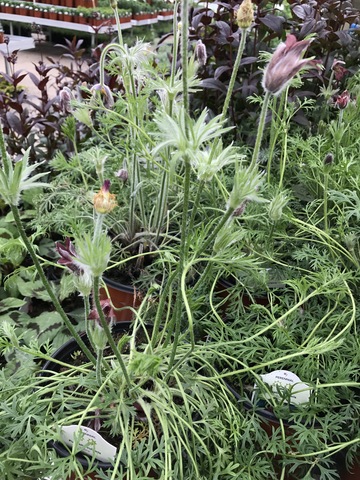
Red Pasqueflower (Pulsatilla vulgaris 'Rubra')
pull-sah-TIL-lah vul-GAR-iss ROO-brah

Deciduous Perennial
Pulsatilla vulgaris, the Pasque Flower, is a European and southwest Asian wildflower and one of the earliest perennials to bloom each spring. Silky, hairy flower stems emerge from the ground as early as March, opening into large, upward-facing violet-to-purple (rarely white) cups with a bright yellow center of stamens. Finely divided, fern-like foliage follows the flowers and remains attractive through the season, and the blooms give way to showy, plume-like seed heads. Low and mounding, it forms a tidy rosette well suited to rock gardens and border fronts.

Pros

  • One of the earliest perennials to bloom, often in March
  • Showy violet flowers with bright yellow centers, followed by ornamental plumed seedheads
  • Fine, silky-haired, fern-like foliage stays attractive all season
  • Deer resistant and drought tolerant once established

Cons

  • All parts are irritating if eaten or handled fresh — can cause mouth pain, skin irritation, vomiting, and diarrhea
  • Needs sharp drainage; dislikes soggy soil
  • Short-lived bloom period
 

Plant Data

Tags Deciduous, Perennial
Flower Color
Want More photos of this plant? Try Google Image Search!


Pricing and Availability History

Click a label to toggle visibility for that size


© North Shore Plant Club 2026. Privacy Policy, Terms & Conditions.

Field-Grown vs. Greenhouse-Grown Plants

Plants which are well-adapted to our local climate are most often field-grown (outside). Field-grown plants are generally cheaper and have the advantage of already somewhat acclimated to our cold winters, but that means they’re not artificially far along in the spring and tend to bloom at the normal time in our area.

Spring annuals and tender perennials are typically grown in Greenhouses so they can be ready and luxurious exactly when customers want them. Some perennials are also “forced” into early bloom in greenhouses. In May, there can be a very big difference between field-grown and greenhouse-grown plants of the same type. The latter typically look good right away (so they’re a great choice where that’s important), but we typically pay a premium for it.


Estimated Recipe Cost

The cost of this recipe's ingredients will vary depending on the season and the sizes and varieties you select.


Benefits of Membership

Want a better way to get great plants and make your yard look awesome? Create your account below and get:

  • The best plants… from the same sources the pros use, but at near wholesale prices
  • More plants in more sizes than anywhere else… whether you’re looking for classics or rarities; annuals, perennials or shrubs; one plant or a whole yardful!
  • "No Contact" delivery or easy pick-up at a site near you without fighting the retail crowds. You choose!

Membership is free, but — since we rely on delivery and local pick-up — you have to live near one of our hubs (or be willing to drive to a site to pick them up). If you live farther away, and would like to help us bring the club to your neighbors, please email helpusgrow@northshoreplantclub.com.

Already a member?
Login
About Ordering From The Plant Club

To secure the best prices for club members and make sure we know the current plants available from each nursery, we take orders only a couple of times a month.

Shoot us an email at help@northshoreplantclub.com, and we'll be happy to talk about plants or let you know when it's time to buy them!


No Pricing or Availability Right Now

We order from a rotating cast of the best nurseries in the Great Lakes region. It looks like we've offered this plant in the past, but the nurseries we're working with this week don't appear to have it in stock at the moment.

Our goal is to bring as many plants together under "one roof" as possible, so we'll try hard to make it available again in the future!