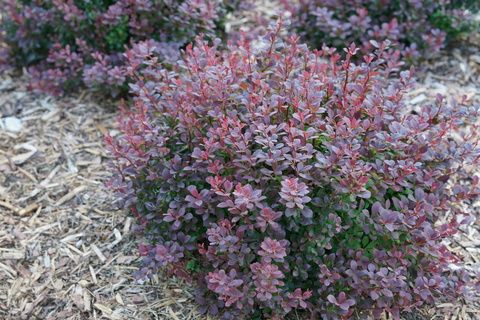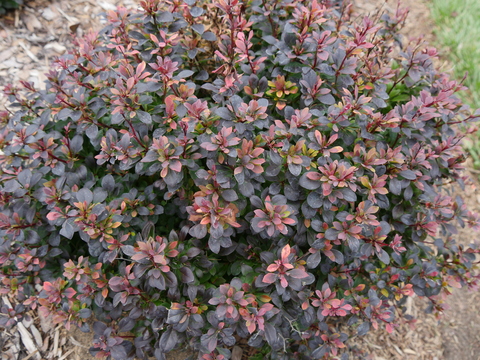
Sunjoy Todo Barberry (Berberis x 'NCBX1' SUNJOY TODO)
BER-ber-iss ex 'NCBX1' SUNJOY TODO

Semi-Evergreen Perennial (usually grown as an annual near you) Dense, Mounded, Rounded Shrub in the Berberidaceae Family
 
Buy Sunjoy Todo Barberry
Size Notes Price Availability
#2 gallon Field

H12in-15in (9/22)

$37.00 Likely available
11/1 - 11/8
1/24 - 4/4

Colorful glossy foliage, bright flowers, neat habit. Semi-evergreen; four season interest. Though the spring blooms do develop red berries.

Sunjoy Todo Barberry is a compact, interspecific hybrid barberry bred by crossing Berberis x media 'Red Jewel' with Berberis thunbergii 'Concorde.' Because one of its parents traces back to an evergreen Chinese barberry species, Sunjoy Todo is semi-evergreen, holding its deep purple to purple-black foliage on branch tips well into winter in milder climates. New growth emerges glossy and richly colored, maturing to a near-black purple that holds through summer and fall without fading or scorching in full sun. In late spring it produces small yellow flowers flushed with red, followed by ornamental red berries; the plant was specifically bred to be sterile, so the berries carry no viable seed and it will not self-sow or spread.

Pros

  • Deep purple-black foliage color holds all season without fading in sun
  • Semi-evergreen, offering four-season structure other barberries lack
  • Bred sterile, so it will not self-sow or spread like straight Japanese barberry
  • Compact, low-maintenance, and deer resistant

Cons

  • Sharp thorns make placement and pruning care important
  • Best foliage color and evergreen retention need full sun; less winter foliage retention in colder zones
  • Berberis in general is regulated in a number of states; check local rules before planting
This plant may be mostly winter-hardy outdoors where you live, but it may need protection to survive extreme weather.
Highlights
  • Interspecific hybrid bred by Dr. Thomas Ranney (NC State), US Plant Patent 29,504
  • Semi-evergreen with near-black purple foliage year-round in mild climates
  • Bred sterile and non-invasive, unlike straight Berberis thunbergii
  • Yellow spring flowers followed by ornamental (seedless) red berries
 

Plant Data

Mature Size 18 - 24 inches tall. 18 - 24 inches wide.
Growth Rate Moderate
Sun Exposure Partial Shade - Full Sun
Moisture Tolerance Dry - Medium:

Tolerates average to dry, well-drained soil once established, including good drought tolerance. Does not tolerate standing water or extended wet conditions.

Zones 6a - 8b (Usually hardy to -10° F)
Tags Colorful Foliage, Deer Resistant, Drought Tolerant, Dry, Foundation, Full Sun, Good for Hedges, Grown For Attractive Foliage, Low Maintenance, Medium, Mounded, Partial Shade, Partial Sun, Perennial, Potentially Toxic, Rabbit Resistant, Semievergreen, Shrub, Thorns, Tolerant of Clay Soil, Well-Drained Soil, Winter Interest
Bloom Period April To May
Flower Color Yellow
Foliage Color Deep Purple

Commonly Planted with...

Its deep purple foliage pairs especially well with chartreuse or gold-leaved companions for contrast, such as heuchera and spirea, or with low, drought-tolerant groundcovers along a border.

Want More photos of this plant? Try Google Image Search!


Pricing and Availability History

Click a label to toggle visibility for that size

Past Availability
2025 : 04/03 - 10/04
2024 : 05/01 - 10/05
2023 : 06/21 - 09/30

© North Shore Plant Club 2026. Privacy Policy, Terms & Conditions.

Field-Grown vs. Greenhouse-Grown Plants

Plants which are well-adapted to our local climate are most often field-grown (outside). Field-grown plants are generally cheaper and have the advantage of already somewhat acclimated to our cold winters, but that means they’re not artificially far along in the spring and tend to bloom at the normal time in our area.

Spring annuals and tender perennials are typically grown in Greenhouses so they can be ready and luxurious exactly when customers want them. Some perennials are also “forced” into early bloom in greenhouses. In May, there can be a very big difference between field-grown and greenhouse-grown plants of the same type. The latter typically look good right away (so they’re a great choice where that’s important), but we typically pay a premium for it.


Estimated Recipe Cost

The cost of this recipe's ingredients will vary depending on the season and the sizes and varieties you select.


Benefits of Membership

Want a better way to get great plants and make your yard look awesome? Create your account below and get:

  • The best plants… from the same sources the pros use, but at near wholesale prices
  • More plants in more sizes than anywhere else… whether you’re looking for classics or rarities; annuals, perennials or shrubs; one plant or a whole yardful!
  • "No Contact" delivery or easy pick-up at a site near you without fighting the retail crowds. You choose!

Membership is free, but — since we rely on delivery and local pick-up — you have to live near one of our hubs (or be willing to drive to a site to pick them up). If you live farther away, and would like to help us bring the club to your neighbors, please email helpusgrow@northshoreplantclub.com.

Already a member?
Login
About Ordering From The Plant Club

To secure the best prices for club members and make sure we know the current plants available from each nursery, we take orders only a couple of times a month.

Shoot us an email at help@northshoreplantclub.com, and we'll be happy to talk about plants or let you know when it's time to buy them!


No Pricing or Availability Right Now

We order from a rotating cast of the best nurseries in the Great Lakes region. It looks like we've offered this plant in the past, but the nurseries we're working with this week don't appear to have it in stock at the moment.

Our goal is to bring as many plants together under "one roof" as possible, so we'll try hard to make it available again in the future!