 North Shore Plant Club
- Shop For Plants
- Search Plants
- Resources for Gardeners
- Color Wheel of Plants
- Interactive Landscapes
- Photos of Planters & Hanging Baskets
- November Photos from Our Community
- Botanic Gardens: Chicago & Beyond
- Local Nurseries
- Upcoming Plant Events
- Plant Club Articles & Answers
- Gardening in the News
- Chicagoland Garden Calendar
- Explaining Plant Container Sizes
- Thrillers, Fillers & Spillers
- Join Free!
- Mundelein
Cobalt-n-Gold St. John's Wort (Hypericum kalmianum 'PIIHYP-I' COBALT-N-GOLD)
|
|||||
| Deciduous Perennial Shrub, Compact Mounding in the Hypericaceae Family | |||||
Buy Cobalt-n-Gold St. John's Wort | |||||
|
|||||
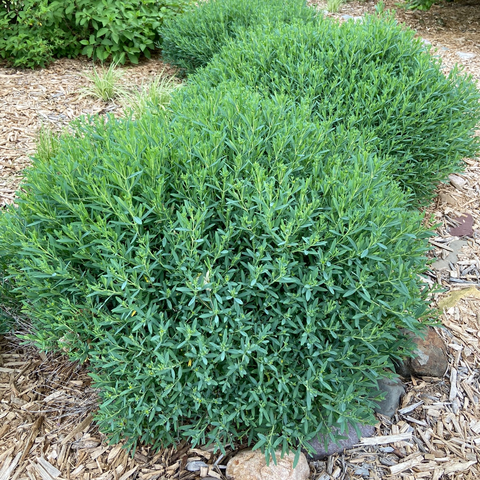
Silver-green foliage is covered with sunny yellow flowers in the spring, giving way to an array of orange and red for fall interest. The bark is exfoliating, offering attractiveness in winter. |
|||||
|
Hypericum kalmianum 'PIIHYP-I', sold as Cobalt-n-Gold St. John's Wort, is a distinctive cultivar bred by Joshua H. Kardos and Michael A. Dirr for Plant Introductions, Inc. It originated in 2008 from open-pollinated seed in a breeding program in Watkinsville, Georgia, and was patented in 2015 (US Plant Patent PP25,318). Unlike the species and most other Kalm's St. John's Wort cultivars, 'Cobalt-n-Gold' has striking silver-green, glaucous foliage that turns shades of yellow, orange, and red in fall. It blooms earlier than the species too, producing bright yellow flowers from late spring into early summer, each lasting about five days. The compact, mounding shrub has sturdy stems that resist splaying with age, and on second-year and older stems the cinnamon-brown bark exfoliates in papery strips, adding a extra season of interest in winter. It reaches about 2 to 3 feet tall and spreads 4 to 5 feet wide, and like the rest of the genus it tolerates a wide range of soil conditions, from brief standing water to drought once established. |
|||||
Pros
|
|||||
Cons
|
|||||
| Highlights | A standout foliage plant among St. John's Wort cultivars -- silver-green leaves, early-season yellow flowers, fall color, and exfoliating winter bark all in one compact shrub. | ||||
Plant Data | |||||
| Mature Size | 24 - 36 inches tall. 4 - 5 feet wide. | ||||
| Sun Exposure | Partial Shade - Full Sun | ||||
| Moisture Tolerance | Dry - Wet: Tolerates poor, rocky, or wet soils, including brief standing water, as well as drought once established. | ||||
| Zones | 4a - 7b (Usually hardy to -30° F) | ||||
| Tags | Attracts Bees, Attracts Butterflies, Attracts Pollinators, Attracts Wildlife, Deciduous, Deer Resistant, Drought Tolerant, Dry, Extended Bloom Time, Fruit showy, Full Sun, Good for Borders, Good for Mass Planting, Good for Rock Garden, Good for Rocky Soil, Low Maintenance, Medium, Nativar, Non-Allergenic, Normal Soil, Partial Shade, Partial Sun, Perennial, Potentially Toxic, Rabbit Resistant, Showy Flowers, Shrub, Tolerant of Moist Soil, Tolerant of Sandy Soil, Well-Drained Soil, Wet, Winter Interest | ||||
| Bloom Period | Late Spring to Early Summer | ||||
| Flower Color | Bright Yellow | ||||
| Foliage Color | Silver-green | ||||
Most Popular Plants |
|||||
|
"Fruit showy" #25
|
|||||
Commonly Planted with...Pairs well with other sun-loving shrubs and perennials that appreciate similar soil flexibility, such as Spirea, Panicum (switchgrass), and Rudbeckia, or in a rain garden alongside Iris versicolor and Asclepias incarnata. |
|||||
| |
|
Want More
photos of this plant? Try
Google Image Search!
|
|
Pricing and Availability HistoryClick a label to toggle visibility for that size
|
|
Past Availability2025 : 04/13 - 10/042024 : 05/01 - 10/05 2023 : 08/24 - 09/30 |
|