 North Shore Plant Club
- Shop For Plants
- Search Plants
- Resources for Gardeners
- Color Wheel of Plants
- Interactive Landscapes
- Photos of Planters & Hanging Baskets
- November Photos from Our Community
- Botanic Gardens: Chicago & Beyond
- Local Nurseries
- Upcoming Plant Events
- Plant Club Articles & Answers
- Gardening in the News
- Chicagoland Garden Calendar
- Explaining Plant Container Sizes
- Thrillers, Fillers & Spillers
- Join Free!
- Mundelein
Pickerel Weed (Pontederia cordata)
|
|
| Deciduous Perennial Upright, Clump-Forming in the Pontederiaceae Family | |
A native wetland perennial with long-blooming blue-violet flower spikes held above arrowhead-shaped leaves — equally at home softening a pond edge or helping keep the water clear. |
|
|
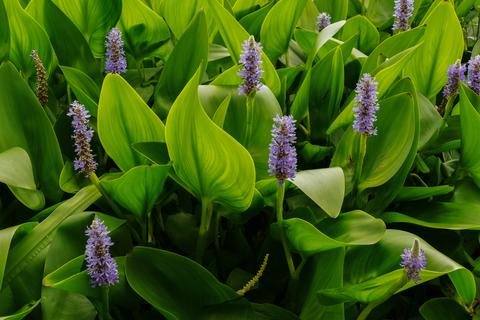
Pontederia cordata, commonly called Pickerelweed, is a native North American aquatic perennial grown as an emergent marginal plant — rooted in mud or shallow water with its glossy, arrowhead-shaped leaves and flower spikes held above the surface. Dense spikes of small, tubular blue-violet flowers bloom from the bottom up over a long season, from roughly June to October, prolonging the show for weeks at a time. In the wild it grows in the shallow water of marshes, ponds, swamps, and slow-moving streams, native to a wide range stretching from eastern Canada south to Florida and Texas, and found natively in scattered wetland sites across Illinois. Its showy, starchy seeds are edible (traditionally eaten raw, cooked, or ground into flour) and its young leaf stalks can be used as salad greens or cooked like spinach, though raw seeds have occasionally been reported to irritate the mouth. Beyond its own flowers, Pickerelweed pulls real weight in a water garden: its dense colonies take up excess nutrients and help keep pond water clear, while providing cover for fish and egg-laying sites for dragonflies and damselflies at the water’s edge. |
|
Pros
|
|
Cons
|
|
| Why Like | A genuine Illinois native, found in scattered wetland sites across the northeastern, western, and southern parts of the state, growing in the shallow water of marshes, swamps, ponds, and slow-moving streams. Its flowers draw bumblebees and other bees — including two specialist bees that depend on its pollen — along with sulfur and other butterflies. Ducks such as Mallards, Wood Ducks, and Green-winged Teal eat the seeds, and muskrats and deer occasionally browse the foliage; dense colonies also give fish and other aquatic life valuable cover. |
| Highlights | A genuine Illinois-native wetland plant with one of the longer bloom windows of any native aquatic (June to October); doubles as a natural water-clarifying plant for ponds. |
Plant Data | |
| Mature Size | 24 - 48 inches tall. 18 - 24 inches wide. |
| Growth Rate | Fast |
| Sun Exposure | Partial Shade - Full Sun |
| Moisture Tolerance | Wet |
| Zones | 3a - 10b (Usually hardy to -40° F) |
| Tags | Attracts Bees, Attracts Birds, Attracts Butterflies, Attracts Pollinators, Deciduous, Edibles, Full Sun, Good for Butterfly Garden, Good for Rain Garden, Illinois Native, Native to North America, Naturalizing, Partial Shade, Partial Sun, Perennial, Pond, Showy Flowers, Wet, Wet Site Tolerant |
| Bloom Period | June to October |
| Flower Color | Blue-Violet
|
More Info from Experts |
|
| |
|
Want More
photos of this plant? Try
Google Image Search!
|
|
Pricing and Availability HistoryClick a label to toggle visibility for that size
|
|
Past Availability2025 : 04/03 - 09/062024 : 05/01 - 10/05 2023 : 05/18 - 09/24 |
|