 North Shore Plant Club
- Shop For Plants
- Search Plants
- Resources for Gardeners
- Color Wheel of Plants
- Interactive Landscapes
- Photos of Planters & Hanging Baskets
- September Photos from Our Community
- Botanic Gardens: Chicago & Beyond
- Local Nurseries
- Upcoming Plant Events
- Plant Club Articles & Answers
- Gardening in the News
- Chicagoland Garden Calendar
- Explaining Plant Container Sizes
- Thrillers, Fillers & Spillers
- Join Free!
- Mundelein
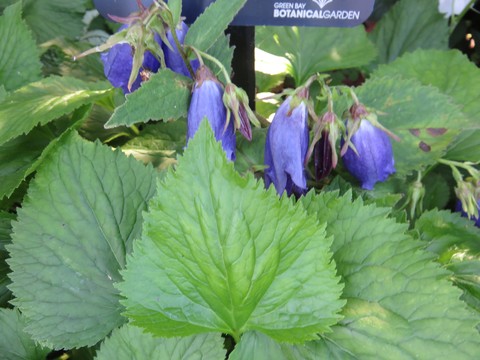
Gloaming Greet Bellflower (Campanula latiflora 'Gloaming')
|
|
| Deciduous Perennial in the Campanulaceae Family | |
|
Campanula latifolia, the giant bellflower, is a species of bellflower in the family Campanulaceae. It is also known as the large campanula and the wide-leaved bellflower. It is native to Europe and western Asia and is widely grown as an ornamental plant. Campanula latifolia is a clump-forming perennial herbaceous plant growing to a height of 60 to 120 centimetres (24 to 47 in). The stem is unbranched, erect ,and shortly pubescent, basal leaves are stalked, broadly ovate with a heart-shaped (cordate) base, while the upper leaves are ovate-lanceolate, stalkless, softly hairy with bluntly toothed margins. The inflorescence is a many-flowered terminal raceme or in the axils of upper leaves and has subtending bracts. The flowers are hermaphrodite, bell-shaped, initially erect but later nodding ,and 35 to 60 mm (1.4 to 2.4 in) long. The calyx is fused with five narrow lobes, eventually spreading. The corolla is pubescent with five dark violet-blue fused petals. There are five stamens and a pistil formed from three fused carpels. The fruit is a hairy, nodding capsule. The flowering period is from July to September. |
|
Plant Data | |
| Mature Size | 3 - 4 feet tall. 18 - 24 inches wide. |
| Sun Exposure | Partial Shade - Full Sun |
| Moisture Tolerance | Medium |
| Zones | 4a - 8b (Usually hardy to -30° F) |
| Tags | Attracts Bees, Attracts Hummingbirds, Container, Deciduous, Deer Resistant, Edging, Extended Bloom Time, Fast Growth Rate, For a Shady Spot, Full Sun, Good for Accents, Good for Beginners, Good for Borders, Good for Cottage Garden, Good for Cut Flowers, Good for Mass Planting, Good for Rock Garden, Medium, Medium, Non-Allergenic, Normal Soil, Partial Shade, Partial Sun, Perennial, Rabbit Resistant, Showy Flowers, Tolerant of Clay Soil, Tolerant of Moist Soil, Well-Drained Soil, Woodland Garden |
| Bloom Period | June to July |
| Flower Color |
|
In The News |
|
More Info from Experts |
|
| |
|
Want More
photos of this plant? Try
Google Image Search!
|
|
Pricing and Availability HistoryClick a label to toggle visibility for that size
|
|
|
|
|