 North Shore Plant Club
- Shop For Plants
- Search Plants
- Resources for Gardeners
- Color Wheel of Plants
- Interactive Landscapes
- Photos of Planters & Hanging Baskets
- September Photos from Our Community
- Botanic Gardens: Chicago & Beyond
- Local Nurseries
- Upcoming Plant Events
- Plant Club Articles & Answers
- Gardening in the News
- Chicagoland Garden Calendar
- Explaining Plant Container Sizes
- Thrillers, Fillers & Spillers
- Join Free!
- Mundelein
Oertel's Rose Yarrow (Achillea millefolium 'Oertel's Rose')
|
|
| Deciduous Perennial Upright, Spreading in the Asteraceae Family | |
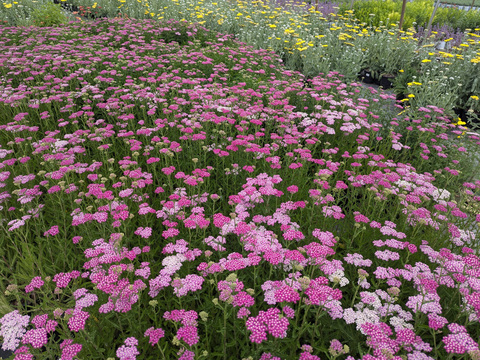
Compact, rosy-pink flower clusters over silvery, ferny foliage — a shorter, sturdier yarrow selection that resists flopping and blooms most of the summer. Thrives in dry, lean soil and full sun with minimal care. |
|
|
'Oertel's Rose' is a naturally compact selection of common yarrow (Achillea millefolium), notable for staying shorter and sturdier than typical seed-grown forms of the species, which tend to grow tall and flop over. According to North Creek Nurseries, the plant traces back to a roadside specimen dug by Mae Oertel, who brought it from the Midwest to Athens, Georgia around 1983; its compact habit proved superior enough to seed-grown yarrow that it was propagated on as a named selection. It does not appear to be a patented cultivar. From early to late summer, flattened clusters of deep rose-pink flowers rise above finely divided, silvery-green, fern-like foliage. Like other forms of common yarrow, it is extremely drought tolerant once established and performs best in full sun and lean, well-drained soil — rich or consistently moist conditions encourage floppy growth and disease. Because it spreads by rhizomes and reseeds readily, and because seed-grown offspring will not reliably retain the compact habit or flower color, propagate true-to-type plants by division or stem cuttings rather than seed. |
|
Pros
|
|
Cons
|
|
| Highlights | A compact, non-flopping selection of common yarrow prized for its rosy-pink, long-blooming flowers over silvery, ferny foliage — extremely drought tolerant, deer-resistant, and a magnet for pollinators. |
Plant Data | |
| Mature Size | 24 - 30 inches tall. 24 - 48 inches wide. |
| Growth Rate | Fast |
| Sun Exposure | Full Sun - Full Sun |
| Moisture Tolerance | Dry - Medium: Prefers dry to medium moisture and good drainage; drought tolerant once established. Avoid consistently wet or waterlogged soil, which increases the risk of root and crown rot. |
| Zones | 3a - 9b (Usually hardy to -40° F) |
| Tags | Attracts Beneficial Insects, Attracts Birds, Attracts Butterflies, Attracts Pollinators, Attracts Wildlife, Deciduous, Deer Resistant, Drought Tolerant, Dry, Extended Bloom Time, Fast Growth Rate, Formal Garden, Fragrant Flowers, Fragrant Foliage, Full Sun, Full Sun, Good for Borders, Good for Butterfly Garden, Good for Cottage Garden, Good for Cut Flowers, Low Maintenance, Medium, Nativar, Naturalizing, Normal Soil, Perennial, Prairie Garden, Rabbit Resistant, Repels Unwanted Insects, Showy Flowers, Thrillers, Tolerant of Clay Soil, Tolerant of Moist Soil, Tolerant of Poor Soil, Tolerant of Salt, Tolerant of Sandy Soil, Well-Drained Soil, Woodland Garden |
| Bloom Period | June to September |
| Flower Color | Pink
|
More Info from Experts |
|
Commonly Planted with...Echinacea, Rudbeckia, Salvia, Nepeta, Agastache, Coreopsis, Sedum, and ornamental grasses — plants that share its preference for full sun and lean, well-drained soil. |
|



| |
|
Want More
photos of this plant? Try
Google Image Search!
|
|
Pricing and Availability HistoryClick a label to toggle visibility for that size
|
|
Past Availability2025 : 04/13 - 09/202024 : 05/01 - 09/21 2023 : 05/04 - 09/30 |
|