 North Shore Plant Club
- Shop For Plants
- Search Plants
- Resources for Gardeners
- Color Wheel of Plants
- Interactive Landscapes
- Photos of Planters & Hanging Baskets
- October Photos from Our Community
- Botanic Gardens: Chicago & Beyond
- Local Nurseries
- Upcoming Plant Events
- Plant Club Articles & Answers
- Gardening in the News
- Chicagoland Garden Calendar
- Explaining Plant Container Sizes
- Thrillers, Fillers & Spillers
- Join Free!
- Mundelein
Wild Garlic (Allium canadense)
|
|
| Deciduous Perennial Clumping-forming in the Amaryllidaceae Family | |
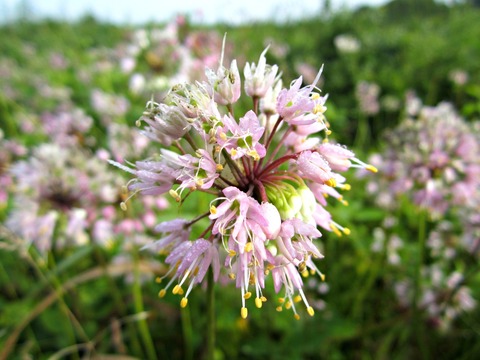
Sparse cluster of grass-like leaves and its flowering stalk grow from a bulb. From between leaves rises a stem topped by a dome-like cluster of star-shaped pink or whitish flowers; plant has strong onion-like odor. |
|
| Allium canadense is a bulbous perennial native to nearly every county in Illinois and found across most of eastern and central North America, where it is the most common native wild onion. It grows readily in prairies, meadows, open woods, and even lawns, spreading by underground bulb offsets and, distinctively, by aerial bulblets that form within the flower cluster itself - a reliable identification feature that separates this species from other native onions. The pink or white, star-shaped flowers appear in early summer and, along with the bulbs and leaves, are edible with a mild onion flavor, though the plant is best known to most gardeners as a common, if unassuming, lawn and meadow wildflower. | |
Pros
|
|
Cons
|
|
| Why Like | One of the most widespread native onions in Illinois, found in every county, Wild Garlic is a reliable early-summer nectar source for bees and other pollinators and asks for nothing in return - it thrives in sun or shade and in almost any soil. Its bulbs, leaves, and flowers are all edible, with a mild onion flavor, and it has a long history of use as a foraged wild edible. |
Plant Data | |
| Mature Size | 8 - 12 inches tall. 8 - 12 inches wide. |
| Growth Rate | Fast |
| Sun Exposure | Partial Shade - Full Sun |
| Moisture Tolerance | Medium : Tolerates dry to medium-wet conditions; quite adaptable once established. |
| Zones | 4a - 8b (Usually hardy to -30° F) |
| Tags | Attracts Butterflies, Attracts Pollinators, Attracts Wildlife, Bulbs for Fall Planting, Container, Deciduous, Deer Resistant, Disease Resistant, Drought Tolerant, Extended Bloom Time, Fragrant Foliage, Full Sun, Good for Borders, Good for Butterfly Garden, Good for Cottage Garden, Good for Cut Flowers, Good for Mass Planting, Groundcover, Illinois Native, Low Maintenance, Medium, Medium, Most Popular, Native to North America, Naturalizing, Non-Allergenic, Normal Soil, Ornamental, Partial Shade, Partial Sun, Perennial, Potentially Toxic, Rabbit Resistant, Showy Flowers, Tolerant of Clay Soil, Tolerant of Loamy Soil, Tolerant of Poor Soil, Tolerant of Sandy Soil, Well-Drained Soil, Woodland Garden |
| Bloom Period | May-July |
| Flower Color | Pink
|
| Foliage Color | Green |
Most Popular Plants |
|
In The News |
|
|
|
| |
|
Want More
photos of this plant? Try
Google Image Search!
|
|
Pricing and Availability HistoryClick a label to toggle visibility for that size
|
|
Past Availability2025 : 04/03 - 10/042024 : 05/01 - 10/05 2023 : 05/04 - 06/25 |
|