 North Shore Plant Club
- Shop For Plants
- Search Plants
- Resources for Gardeners
- Color Wheel of Plants
- Interactive Landscapes
- Photos of Planters & Hanging Baskets
- October Photos from Our Community
- Botanic Gardens: Chicago & Beyond
- Local Nurseries
- Upcoming Plant Events
- Plant Club Articles & Answers
- Gardening in the News
- Chicagoland Garden Calendar
- Explaining Plant Container Sizes
- Thrillers, Fillers & Spillers
- Join Free!
- Mundelein
Lady Fern (Athyrium filix-femina)
|
|
| Deciduous Perennial Upright, Clump-Forming in the Athyriaceae Family | |
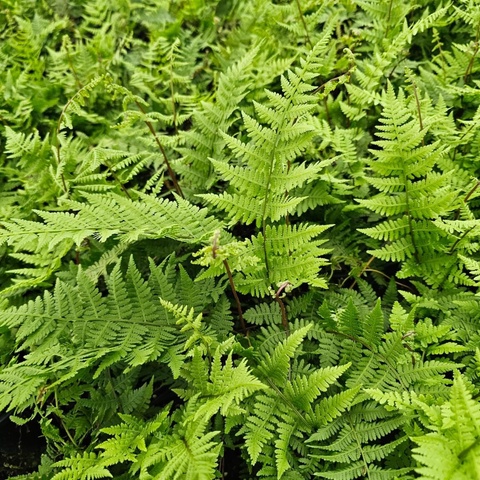
Discover the elegance of Lady Fern, featuring delicate bright green leaves that dance gracefully in the breeze. This lush, vibrant fern adds a touch of softness and tranquility to any shaded garden space. |
|
| Athyrium filix-femina, commonly called Lady Fern, is a deciduous, clump-forming fern native to moist woodlands across much of the Northern Hemisphere, including most of Illinois. Its finely divided, lance-shaped fronds emerge bright green in spring from a central crown and arch gracefully outward, creating a soft, lacy texture that contrasts nicely with broader-leaved shade perennials. The species name "filix-femina" (literally "female fern") distinguishes it from the coarser-textured male fern (Dryopteris filix-mas), a naming convention dating to early herbalists who associated its delicate fronds with femininity. Lady Fern spreads slowly from a central rootstock rather than aggressively by rhizome, so it stays well-behaved in a shaded border or woodland garden. | |
Pros
|
|
Cons
|
|
| Why Like | In the wild, Lady Fern forms loose colonies in moist woodlands, ravines, and seep edges, providing year-round ground cover in shaded habitats. Its direct value to wildlife is considered modest, but its dense fronds offer cover for small animals and nesting material for birds, and its slow spread makes it a stabilizing presence on shaded slopes and streambanks without becoming aggressive. |
| Highlights | A classic, easy-care native fern valued for its finely cut, lacy fronds and adaptability to a range of shady conditions from full shade to a few hours of sun. One of the most widely distributed ferns in the world, occurring across temperate regions of the Northern Hemisphere, including most of Illinois. |
Plant Data | |
| Mature Size | 24 - 36 inches tall. 18 - 24 inches wide. |
| Growth Rate | Medium |
| Sun Exposure | Full Shade - Full Sun |
| Moisture Tolerance | Medium - Wet |
| Zones | 3a - 8b (Usually hardy to -40° F) |
| Tags | Deciduous, Deer Resistant, Filler, For a Shady Spot, Full Shade, Full Sun, Good for Accents, Good for Beginners, Good for Borders, Good for Mass Planting, Grown For Attractive Foliage, Illinois Native, Low Maintenance, Medium, Most Popular, Native to North America, Naturalizing, Normal Soil, Partial Shade, Partial Sun, Perennial, Potentially Toxic, Rabbit Resistant, Shade Tolerant, Tolerant of Clay Soil, Tolerant of Moist Soil, Well-Drained Soil, Wet, Woodland Garden |
| Bloom Period | Non-flowering |
| Flower Color | Non-Flowering |
| Foliage Color | Bright Green
|
Most Popular Plants |
|
|
"Colorful Foliage" #3,
"Wet" #3,
"Pond" #3,
"Tolerant of Clay Soil" #5,
"Good for Rock Garden" #7,
"Tolerant of Sandy Soil" #7,
"Good for Asian Garden" #7,
"Illinois Native" #9,
"Native to North America" #9,
"Tolerant of Poor Soil" #9
|
|
In The News |
|
|
|
More Info from Experts |
|
Commonly Planted with...Hostas, Heuchera, Ferns, Astilbe, Brunnera, Pulmonaria, Tiarella, Bleeding Heart, Lamium, Solomon's Seal. |
|




| |
|
Want More
photos of this plant? Try
Google Image Search!
|
|
Pricing and Availability HistoryClick a label to toggle visibility for that size
|
|
Past Availability2025 : 04/03 - 10/042024 : 05/01 - 10/05 2023 : 04/13 - 09/30 |
|