 North Shore Plant Club
- Shop For Plants
- Search Plants
- Resources for Gardeners
- Color Wheel of Plants
- Interactive Landscapes
- Photos of Planters & Hanging Baskets
- October Photos from Our Community
- Botanic Gardens: Chicago & Beyond
- Local Nurseries
- Upcoming Plant Events
- Plant Club Articles & Answers
- Gardening in the News
- Chicagoland Garden Calendar
- Explaining Plant Container Sizes
- Thrillers, Fillers & Spillers
- Join Free!
- Mundelein
Perovskia
|
|
| Deciduous Perennial in the Lamiaceae Family | |
About Russian SagesSalvia yangii, previously known as Perovskia atriplicifolia (/p??r?vski? ætr?pl?s??fo?li?/), and commonly called Russian sage, is a flowering herbaceous perennial plant and subshrub. Although not previously a member of Salvia, the genus widely known as sage, since 2017 it has been included within them. It has an upright habit, typically reaching 1.6–3.9 ft tall, with square stems and grey-green leaves that yield a distinctive odor when crushed. It is best known for its flowers. Its flowering season extends from mid-summer to late October, with blue to violet blossoms arranged into showy, branched panicles. It is native to the steppes and hills of southwestern and central Asia. Successful over a wide range of climate and soil conditions, it has since become popular and widely planted. Several cultivars have been developed, differing primarily in leaf shape and overall height; 'Blue Spire' is the most common. This variation has been widely used in gardens and landscaping. S. yangii was the Perennial Plant Association's 1995 Plant of the Year, and the 'Blue Spire' cultivar received the Award of Garden Merit from the Royal Horticultural Society. The species has a long history of use in traditional medicine in its native range, where it is employed as a treatment for a variety of ailments. This has led to the investigation of its phytochemistry. Its flowers can be eaten in salads or crushed for dyemaking, and the plant has been considered for potential use in the phytoremediation of contaminated soil. |
|
Plant Data | |
| Mature Size | 12 - 48 inches tall. 12 - 48 inches wide. |
| Moisture Tolerance | Dry - Medium: Dry to medium, well-drained soils. |
| Zones | 5a - 9b (Usually hardy to -20° F) |
| Tags | Attracts Butterflies, Attracts Hummingbirds, Attracts Pollinators, Colorful Foliage, Container, Deciduous, Deer Resistant, Dry, Formal Garden, Fragrant Flowers, Full Sun, Good for Accents, Good for Borders, Good for Butterfly Garden, Good for Cottage Garden, Good for Cut Flowers, Good for Mass Planting, Grown For Attractive Foliage, Low Maintenance, Medium, Most Popular, Non-Allergenic, Normal Soil, Perennial, Prairie Garden, Rabbit Resistant, Showy Flowers, Tolerant of Moist Soil, Well-Drained Soil |
| Bloom Period | July to Frost |
| Flower Color | Blue to Violet |
Plant Club Content |
|
More Info from Experts |
|


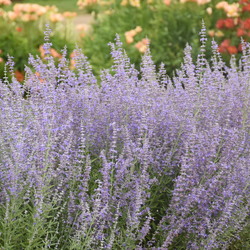
 Jelena Russian Sage