 North Shore Plant Club
- Shop For Plants
- Search Plants
- Resources for Gardeners
- Color Wheel of Plants
- Interactive Landscapes
- Photos of Planters & Hanging Baskets
- October Photos from Our Community
- Botanic Gardens: Chicago & Beyond
- Local Nurseries
- Upcoming Plant Events
- Plant Club Articles & Answers
- Gardening in the News
- Chicagoland Garden Calendar
- Explaining Plant Container Sizes
- Thrillers, Fillers & Spillers
- Join Free!
- Mundelein
Sun King Udo (Aralia cordata 'Sun King')
|
|
| Deciduous Perennial Upright, Mounding in the Araliaceae Family | |
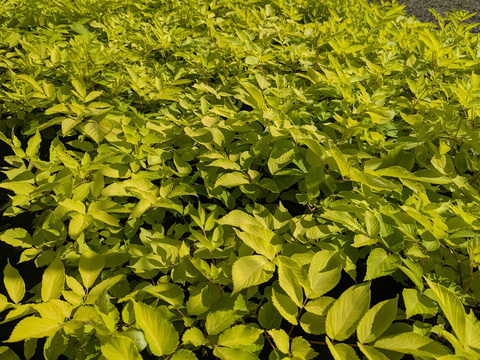
Meet 'Sun King,' a unique golden-leafed that transforms to chartreuse in full shade. Adorned with tiny white flowers and striking deep purplish-black berries, this eye-catching perennial adds a touch of drama to any garden! |
|
|
Aralia cordata 'Sun King' is a bold, clump-forming perennial grown for its striking golden foliage -- despite sometimes being described as a native plant, the species itself, Japanese spikenard, is actually native to woodlands in Japan, Korea, and China, not North America. New growth emerges bright golden-yellow in spring, mellowing toward chartreuse in summer shade (a few hours of morning sun keeps the color more golden), and often returns to gold tones again before dying back in fall. In mid-to-late summer, tall flower stalks rise above the foliage bearing clusters of small white flowers, followed by dark purple-black berries that birds enjoy. An award-winning introduction -- 2012 International Hardy Plant Union Outstanding Plant and 2020 Perennial Plant of the Year -- it brings season-long color to shaded borders. |
|
Pros
|
|
Cons
|
|
| Highlights | Bright golden-yellow spring foliage that shifts toward chartreuse in shade; white summer flowers and bird-friendly purple-black berries; award-winning shade perennial; native to Japan, Korea, and China, not North America. |
Plant Data | |
| Mature Size | 3 - 6 feet tall. 3 - 6 feet wide. |
| Growth Rate | Fast |
| Sun Exposure | Full Shade - Partial Shade |
| Moisture Tolerance | Medium |
| Zones | 3a - 9b (Usually hardy to -40° F) |
| Tags | Attracts Bees, Attracts Butterflies, Colorful Foliage, Container, Deciduous, Deer Resistant, Drought Tolerant, Fall Color, Fall interest, Fast Growth Rate, Filler, For a Shady Spot, Formal Garden, Foundation, Full Shade, Good for Accents, Good for Beginners, Good for Cottage Garden, Good for Rock Garden, Grown For Attractive Foliage, Low Maintenance, Medium, Most Popular, Mounded, Native to Asia, Normal Soil, Partial Shade, Perennial, Rabbit Resistant, Shade Tolerant, Tolerant of Moist Soil, Well-Drained Soil, Yellow Foliage |
| Bloom Period | July to September |
| Flower Color | White |
| Foliage Color | Golden Yellow
|
Awards |
|
Most Popular Plants |
|
|
"Yellow Foliage" #2,
"Fast Growth Rate" #5,
"Colorful Foliage" #12,
"Mounded" #13,
"Native to Asia" #13,
"Good for Rock Garden" #14,
"Fall interest" #16,
"Foundation" #19,
"Fall Color" #21,
"For a Shady Spot" #21
|
|
Commonly Planted with...Hostas, heucheras, tiarella, ferns, astilbe, epimedium, Solomon's seal, and other shade perennials, especially dark-leaved companions like Japanese maple that set off its gold color. |
|
Photos of This with...Misty Lace Aruncus, Ghost Fern, Jack of Diamonds Siberian Bugloss, Mixed Combo Pastels Chrysanthemum: Pink/Peach/Pearl, Neon Star Dianthus, Honeymoon Tropical Sunset Lenten Rose, Quail Jonquilla Daffodil, Northwind Switch Grass, Napier Grass, Trevi Fountain Lungwort, Goldsturm Black-Eyed Susan, Quickcover Yellow Sedum, |
|


| |
|
Want More
photos of this plant? Try
Google Image Search!
|
|
Pricing and Availability HistoryClick a label to toggle visibility for that size
|
|
Past Availability2025 : 04/13 - 10/042024 : 05/01 - 10/05 2023 : 05/04 - 09/30 |
|